








Tomato Traders Move Beyond Sahel
…Now Eyeing Morocco In Life and Death Trips

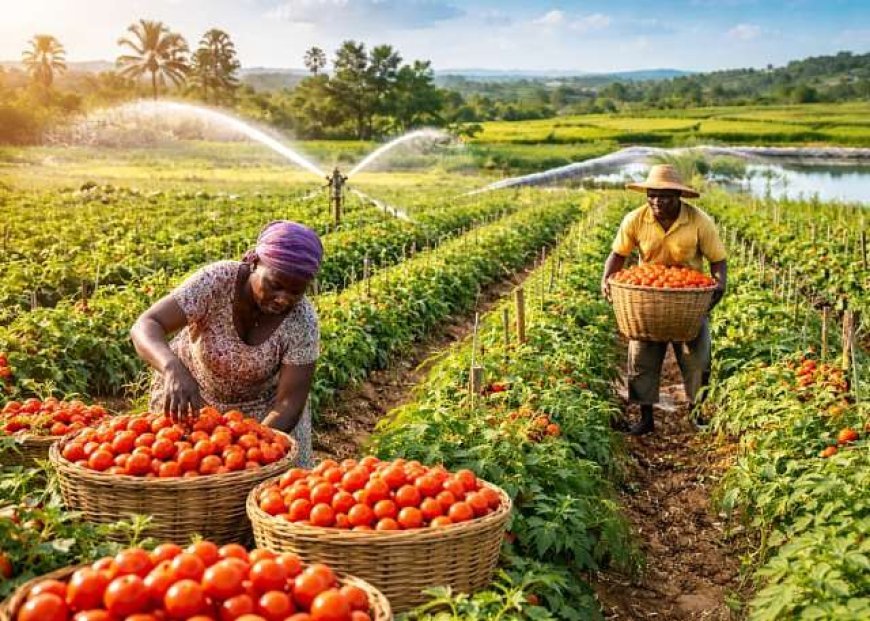
The trade in tomato is getting more intriguing. Insider sources say traders are eying Morocco and other Maghreb countries in search of the almost indispensable vegetable.
By Nana Kwame Owusu
This is notwithstanding the fact that a chunk of the cargo gets rotten before traders, who are used to ferrying cargo in unventilated long trucks, reach base in Kumasi, Koforidua, Ho or Accra.
That means, hikes in prices, food safety and environmental concerns, as well as health issues that impact consumers.
Occasionally, traders try Mali and Morocco. But that was six, seven years ago. Now jihadist and extreme banditry activities have combined to distress their pathological sense of doggedness.
Now, The Inquirer can report that traders in tomato, very desperate, are considering targeting faraway Morocco, dead or alive, according to traders (name withheld) operating within the CMB, Breweries, Railways and Katamanto branches and food security research sources.
That next-door Togo tomato producers are in very recent times replacing our local farmers in bringing tomato to the market for consumers should embarrass, even annoy, ordinary citizens.
The embarrassment is against the background that, each year, Ghanaian universities turn out graduates, including agronomists and agribusiness professionals, who would be chasing jobs in the banks as well as Ministries, Departments and Agencies (MDAs) of Ghana, instead of doggedly getting entrepreneurial.
President JA Kufour and late sector Minister, Courage Quarshigah, noticing the importance of the horticultural or fruit and vegetable chain in job creation and industrialisation, went into a cooperation deal with Italy.
It was a bold attempt in 2002 to revamp the sector, which by 1998, was starkly declining, despite the strategic presence of Kwame Nkrumah’s 1965 Vea Irrigation Project of 1965 and Kutu Acheampong’s Tono Irrigation Project of 1972 strategically targeted at realising and enhancing the vision of lean season industrialised tomato production to feed markets in the sub-region, including Burkina Faso, Togo and Benin.
Similarly, the NDC, under President John Mahama and Trade Minister Hannah Serwah Tetteh, revisited the conversation, attempting to latch onto the then ECOWAS economic integration dream and protocols to reignite the sector.
Unfortunately, this paper gathered, the harm had gone deeper than imagined as raw material capacity to fire the heavy-duty plant procured for the Northern Star Tomato Factory became a waterloo.
Intriguingly, that challenge would be confronting interested investors in the Middle Belt and culminate in a near collapse of the sector.
An IFPRI Washington said that, while investors and tomato factories, including Northern Star tried to arrange to produce their own raw materials, erratic rainfall consistently ate up all production activities as farms got flooded and inconsistent weather patterns hurt tomato production in the Middle Belt.
What does the ordinary farmer do when erratic rainfall becomes the norm along the stretch, with the ecology and tomato economy threatened by activities such as degradation, including galamsey, major cause of climate change in Ghana?
As at the time of writing this story, Nkenkensu, Akumadan, Tuobodom, Tano, Offinso, Derma, Techiman and other traditional tomato production in the Ashanti Region and Middle Belt have faded into economic insignificance – with overaged farmers moving into cashew and mango.
Up North, too, vegetable producers have moved into Soya – away from the original production vision with the overaged farmers abandoning tomato on account of the loss of market to Burkina Faso.
The interesting twist is that the Ghana Mission in 2010 in a file to Accra, proposed a sharing of best practices in tomato production which Burkina Faso bought, submitting a supporting proposal regarding a PPP Fruit and Vegetable Chain that Blaise Compaore successors may have shelved or still considering.
The other leg to the saga is that, since the last 25 years, Burkina Faso has allowed Ghanaian tomato producers living in the Upper East and particularly Navrongo, Paga, Chiana and Bawku as well as Zebilla to enter their irrigation sites in the spirit of economic integration to produce tomato and onions and which get through the borders to Ghanaian markets.
It is emerging that Hon Hannah Tetteh as Trade Minister, had been engaging cross border economic actors and had even recommended formalisation of the sector and standardisation of production, marketing and processing practices as a critical ingredient in job creation in line with faster growth prescriptions in the sub-region.
She had also cited around 2015 recommended plastic crates manufacturing company to traders in piloting standardised 50kg plastics packaging to minimise lingering intrigues in the trade
Along that same line, Burkina Faso had appointed an official bank – First Atlantic – to handle financial transactions in arresting acts of banditry as well as the other recorded concerns over traders and goro boys cheating tomato producers in credit-and-abscond games.
As typical Ghanaians, who benefit from informality, the response from the association was not proactive, culminating in recurring tragedies, including the one that, only weeks ago, took the lives of eight traders, predominantly women.
As technocrats at the relevant Ministries would admit, the responsibility rested with the private sector to implement those reforms that were in the files of both the Ghana Mission and MOTI in Accra.
Burkina Faso had also complied with an advice in 2009 from the Ghana Embassy to them to move producer-trader transactions away from farm gates into safer Provincial Markets to enhance transparency in financial, packaging, quality control and food safety, as well as secure cargo and person.
To effect that, Blaise had constructed in 2014 a basic cargo handling infrastructure, aside initiating construction of provincial markets, with one launched in North-east Yako, where traders and producers would be signing into trade protocols – a fact also noted in Ghana Mission files in Ouagadougou.
The history of tomato production in Ghana is revealing. Unfortunately, what it highlights our collective failure in sustaining any good thing we initiate.
Indeed, official reports, some of which have been chronicled by the International Food Policy Research Institute IFPRI Washington, indicate that besides the Western and Central Regions, all regions in Ghana 25 years ago produced tomato twice a season.
About 30 years ago, TseAddo, La, Accra, behind the former La Trade Fair Company, Sakumono, the Accra Plains and, particularly, Asutsuare, Volivo and Ada – all produced tomato.
In Ada, a segment of the youth are considering trading off land for tomato production for real estate ventures.
Also in Accra, the Weija, Bortianor and Kokrobite were active 40 years ago. Only Tuba now operates, as a state irrigation facility.
In the Eastern Region, Nsawam, Suhum, and eastwards into the Volta Region, Middle Belt was a major crucible of production and up North into the Savannah, Northern Region, with Upper East, noted for lean season industrial tomato production that had, at a time, fed Burkina Faso, Togo and Benin.
Today, youth in irrigated tomato sites in the Upper East prefer playing intermediary roles, including helping tomato traders to process tomato cargo at the Paga border. That is the worrying picture on how the buoyant sector gradually sunk in 25 years.
Decline in tomato production in the Upper East began when production activity got hit by a browning disease that attacked plants in farmlands in 1998, culminating in under-production and gradual shift from vegetables towards soya, which has a longer shelf life than the tomato economy that Upper East farmers were losing out on.
The vegetable and fruit, agronomists say, thrive on a fair mix of modest rains and quality sunshine – a ‘luxury’ that is no longer assured farmers, especially in the large Middle Belt space that leads tomato production in Ghana.
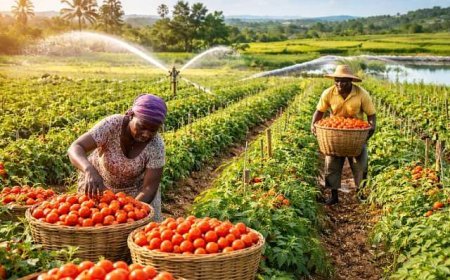
That is why, in the scorching Sahel environment, together with the Savannah environment, irrigation has been as critical to safer, reliable tomato production as against the production practices found in communities in the Middle Belt of Ghana.
The alternative, which is greenhouse cultivation. This basic technology can deliver three production cycles, depending on best practices land management, according to agronomists.
Unfortunately, this technology, which is normal in technologically-driven industrial Asia, Europe as well as South Africa and Morocco, is beyond the financial power of the average Ghanaian.
In the cross-border trade, Ghana produces eight out of the 12 months, while Burkina Faso produced only four, according to an IFPRI source. Both share almost the same lean season calendar, while Ghana has the advantage of both lean season and rain-fed production.
What Burkina Faso has is that they used best practices and are organised in targeting Ghana, Togo and Benin during production calendars. In addition, shelf life of the commodity is optimal, compared to Ghana.
Ghana, together with Nigeria leads as continental and global fresh tomato consuming nations, and Burkina Faso ranking lowest, preferring onions and processed tomato in their sauce than fresh tomato.
Lots of questions begging for answers as far as governance is concerned 68 years on.
What's Your Reaction?
 Like
0
Like
0
 Dislike
0
Dislike
0
 Love
0
Love
0
 Funny
0
Funny
0
 Angry
0
Angry
0
 Sad
0
Sad
0
 Wow
0
Wow
0